
Optimistic Proof of Computation
A revolutionary consensus protocol enabling efficient, secure, and scalable AI computation validation on decentralized networks.
The Problem
The intersection of artificial intelligence and blockchain has been hindered by a fundamental challenge: verification overhead.
|
This creates a seemingly insurmountable barrier to running machine learning models on decentralized networks.
The Cost of Verification
"The combination of AI's computational intensity and blockchain's verification redundancy creates an exponential cost problem."
| Approach | Verification Cost | Scaling | Security |
|---|---|---|---|
| Traditional PoW/PoS | Full network verification | Cost increases linearly with Nodes count | Consensus-based |
| ZK Proofs | Low verification, high proving | Limited by prover capacity, 1000x Overhead | Cryptographic guarantees |
| OPoC | Subset verification | Linear with validators | Economic + Probabilistic |
The OPoC Protocol
OPoC solves the AI-blockchain integration problem with a novel approach that drastically reduces verification costs while maintaining security.
Key Innovation:
Instead of requiring the entire network to verify every computation, OPoC randomly selects a small subset of validators. The probability of selecting all malicious validators becomes vanishingly small as the network grows.
Mathematical Security:
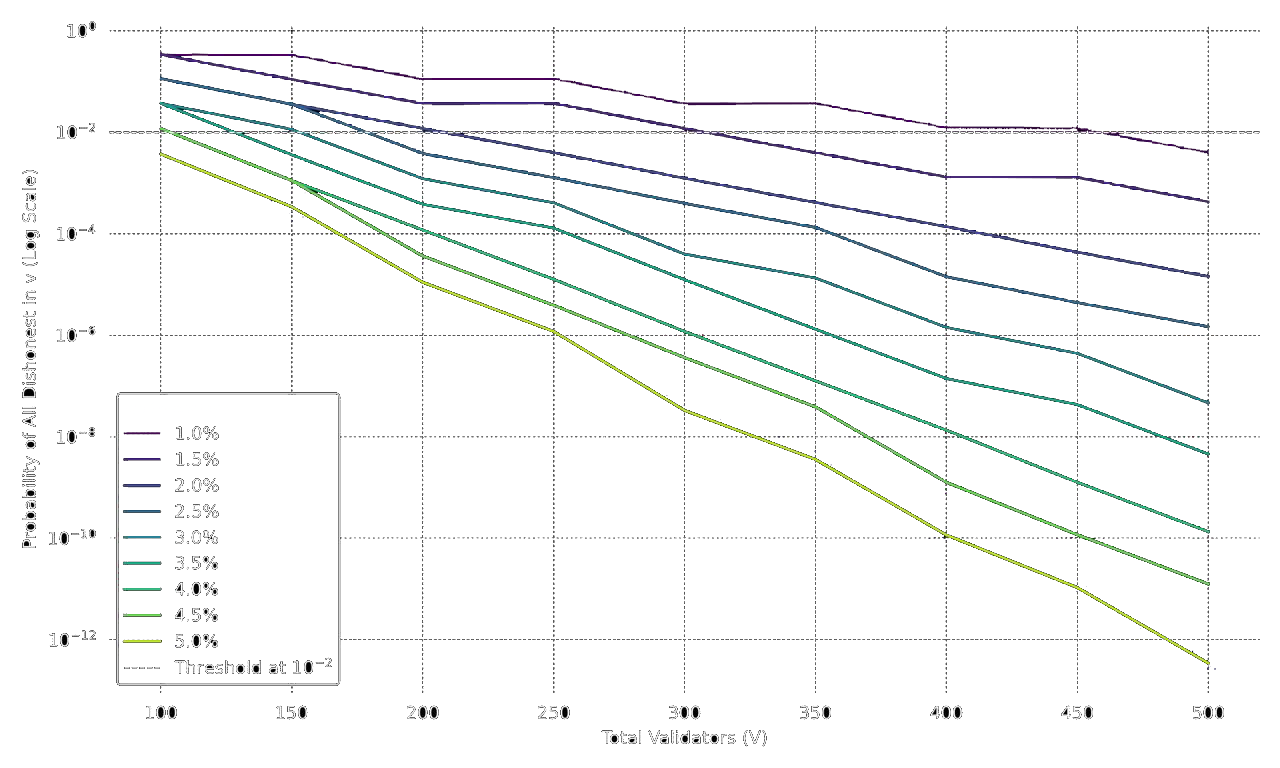
OPoC's security scales exponentially with network size. As validator population V increases, the probability of selecting all Byzantine validators among the random subset v decreases exponentially, while maintaining constant computational effort. The hypergeometric distribution shows that with v/V = 3% and honest ratio H/V = 2/3:

Where V = total validators, v = selected validators, h = honest ratio
This exponential security improvement enables the percentage of participating validators v/V required for consistent security to decrease polynomially as the network grows, providing superior scalability compared to PoS/PoW linear scaling.
The Challenge
Bringing AI to Blockchain
Traditional consensus algorithms like Proof of Work (PoW) and Proof of Stake (PoS) were never designed to verify heavy AI computations. Having every node verify each step of a large model execution would be prohibitively expensive and impossibly slow.
Running a state-of-the-art AI model can require trillions of operations. If every validator had to verify these operations, network costs would be astronomical.
Economic Security Model
How OPoC Makes Attacks Financially Irrational
Each validator must stake tokens with real economic value to participate in the network.
If a validator attempts to verify fraudulent computations, their stake is "slashed" (partially or fully confiscated).
The minimum reward an attacker would need to make cheating worthwhile increases exponentially with network size.
With just 100 validators, 10 partecipants and a $10,000 stake per validator, the economic security per computation can reach over $1 billion.
Minimum Attack Reward Formula:
Economic Security
Attack Probability
Chance of Successful Attack
In a network with 100 validators, with 10 randomly selected for each computation (assuming 1/3 are Byzantine).
OPoC Security Calculator
Explore how OPoC's economic security scales with your network parameters. Adjust the values below to see how stake amounts and validator distribution affect the minimum reward needed to make attacks financially viable.
Economic Security per Inference
Linear Scaling & Parallel Processing
Unique Scaling Properties
Traditional blockchain consensus requires every node to verify every computation, making it impossible to scale throughput by adding more nodes.
With OPoC, adding more validators to the network directly increases parallel processing capacity, creating linear throughput scaling.
Parallel Inference Formula
Where V is the total validator population and v is the number of validators needed per computation
Scalability Comparison
Traditional Consensus
Adding nodes increases redundant computation
ZK-based Systems
High proving costs limit practical scalability
OPoC Protocol
Linear throughput scaling with network size
Deterministic Indeterminism
Embracing Uncertainty, Verifying Truth
Traditional systems attempt to force determinism by eliminating all randomness. But in doing so, they restrict creativity, adaptability, and the natural behavior of intelligent agents.
UOMI introduces Deterministic Indeterminism: an innovative approach that accepts controlled unpredictability, and proves that results are still within defined and verifiable bounds.
Proofs, not Reproduction
Instead of forcing every validator to reach an identical output, UOMI allows slight variations and proves via a probabilistic consensus that the computation was executed faithfully.
Bounded Result Spaces
Validators agree on an expected range of valid outcomes, rather than a single hash. This makes room for intelligent flexibility.
Probabilistic Proofs
Instead of reproducing the exact result, validators verify that an output could plausibly come from the claimed model under shared conditions.
Diversity as a Feature
Agent decisions are no longer constrained by determinism. Instead, systems evolve with a richer, more natural decision space — still verifiable, always honest.
The Future of Decentralized AI
OPoC brings mathematical guarantees and economic alignment to large AI model inference, enabling a new generation of decentralized AI applications.